Categories
News & Blog SUSTAINABILITY

Behind the Scenes: GPA’s Impact on the Car Parts World

Our service is built upon a strong partnership with over 110 certified European dismantler centers. These centers are the backbone of our commitment to customer satisfaction and environmental responsibility. They play a vital role in providing our customers with access to reliable and sustainable solutions for their automotive needs by offering our vast stock of 7 million used car parts.

Established in 1962, French supplier GPA exemplifies excellence in the car dismantling industry. Processing a staggering 24,000 vehicles annually, they meticulously extract and catalog 200,000 high-quality used parts. This dedication to efficiency and sustainability has positioned GPA as a prominent partner, especially since joining forces with Universal AutoParts Ltd in 2022.

The collaboration between GPA and Universal AutoParts Ltd has been a game-changer. GPA can now offer its extensive inventory to an international audience. This expansion benefits customers worldwide and strengthens GPA’s commitment to a more sustainable future for the automotive industry.

GPA Empowering Sustainability: A Vision for the Future

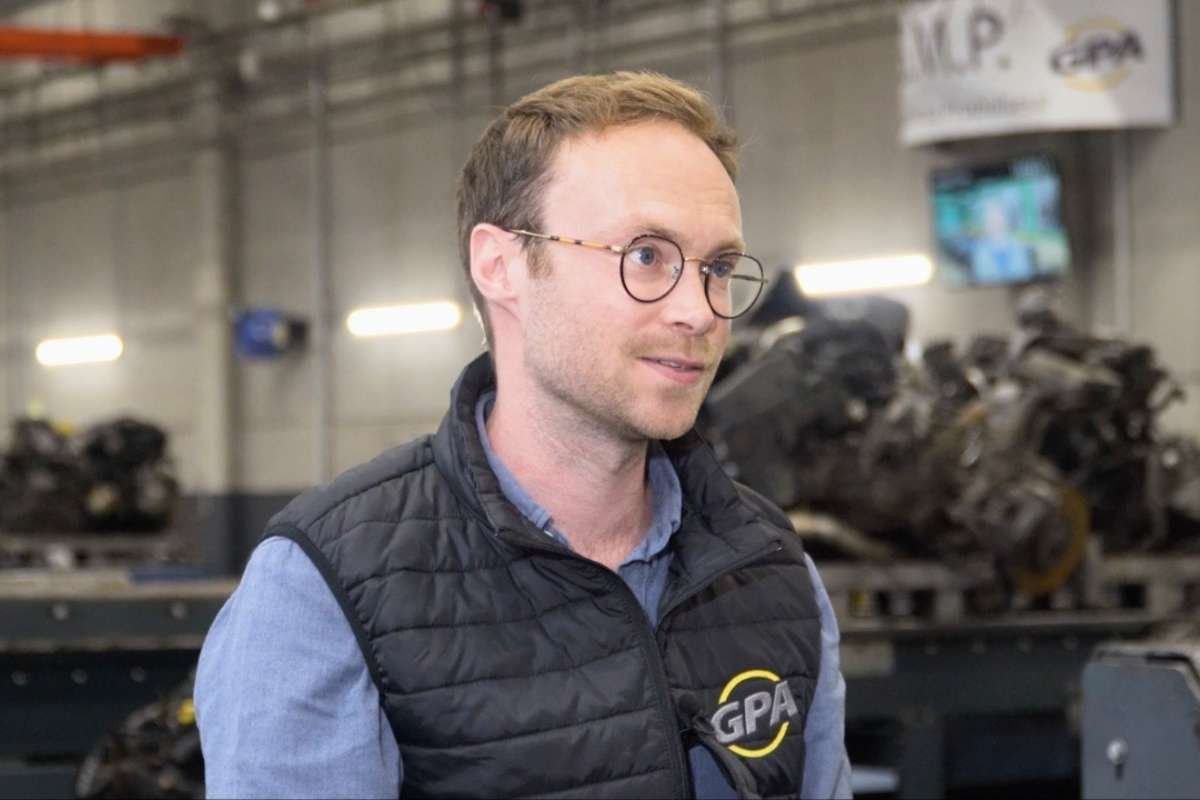
Meet Hugo Barberot, GPA’s Sales Director. In our conversation, Hugo offered insights into the meticulous car dismantling and parts cataloging process. Discover the collaborative partnership that drives our success.

1 – When was the GPA created? And how many cars do you receive annually?

GPA has been a car recycler since 1962, and we treat around 24,000 vehicles a year.

2 – What kind of cars do you buy?

We mainly deal with vehicles from insurance companies, so we have agreements with most of the players in the sector. This allows us to deal with these cars once they are in an accident.

We have a trailer that collects the vehicle in the accident area and then brings it to our space so that we can deal with it. These cars are mostly and mainly from insurance companies.

3 – How many parts are in stock?

We currently have 120,000 auto parts in stock on our website. We produce around 180 to 200 000 parts annually, so we always have over 100 000 car parts.

4 – What services does GPA have?

We sell our parts only remotely via a call center. We also work with Universal AutoParts Ltd to market our parts, especially in countries where we can’t go alone.

5 – Explain the dismantling process from the moment the car arrives at GPA.

Once the vehicle belongs to us, we must follow several steps. First, we evaluate the car to determine which parts will be dismantled. Once this evaluation is done, the automobile will pass through our dismantling workshop, where we have two main circuits in which the vehicle will go through different stages.

We conduct a series of tests on the car’s engine, electrical components, headlights, and taillights. After the initial tests, we disassemble the vehicle and remove the necessary parts (and the ones that will recycled). We prioritize the quality of our parts, ensuring that they are homogeneous and meet high-quality standards.

6 – When was the partnership with Universal AutoParts Ltd established?

The partnership with Universal AutoParts Ltd started in October 2022. We worked for several months with the Universal AutoParts Ltd teams to organize this collaboration. This partnership was significant for us because it allowed us to work with a player with a European dimension and a presence abroad.

7 – What are the advantages you see in our partnership?

Firstly, Universal AutoParts Ltd operates on a slightly different model, which requires us to integrate its complexities into our own model. This was a significant challenge. However, Universal AutoParts Ltd has a global presence, enabling us to expand into markets we were not previously involved in, such as Portugal, Spain, and many other countries that would have been difficult to access independently.

8 – Exports have increased since creating a partnership with Universal AutoParts Ltd?

Since partnering with Universal AutoParts Ltd, we have sold parts in countries we never imagined. I remember selling a part to Chicago, which was a significant increase in our export of car parts.
Categories
News & Blog SUSTAINABILITY

Behind the Scenes: Rodapeças’ Impact on the Car Parts World

At the core of our service lies a strong partnership with over 110 certified dismantler centres in Europe, serving as the backbone of our commitment to environmental responsibility. These centres are crucial to providing our vast stock of 7 million used car parts, ensuring our customers access reliable and sustainable solutions for their automotive needs.

Rodapeças stands out as a prominent player and partner in the car dismantling and recycling industry. Established in 1990 by Carlos Rosa, Rodapeças began its journey with a singular focus on used car parts. However, over the years, it has evolved into providing new and used parts for a variety of vehicles, including family, commercial, and 4x4s.

The strategic partnership between Rodapeças and Universal AutoParts Ltd forged in 2015, marks a significant milestone in the company’s trajectory.

Rodapeças Empowering Sustainability: A Vision for the Future

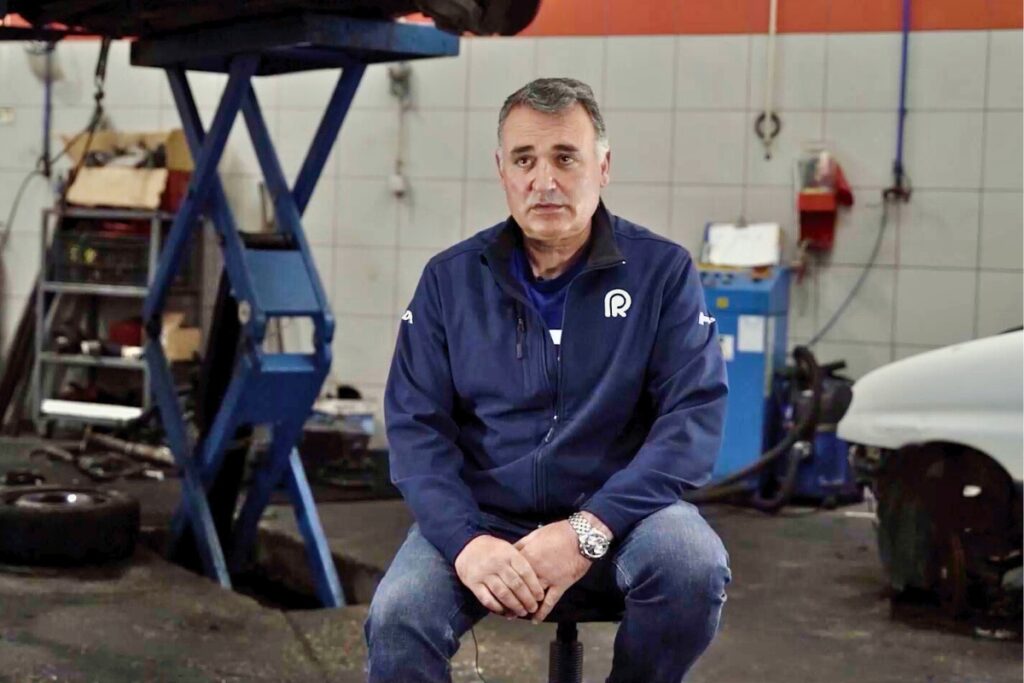
Meet Manuel Vicente, a key figure in Rodapeças’ administration. During our conversation, Vicente emphasized that the collaboration has facilitated the seamless integration of digital technologies into their business model and opened doors to new markets.

With a renewed focus on sustainability and innovation, the collaboration between Rodapeças and Universal AutoParts Ltd aims to set new standards of excellence.

1 – When was Rodapeças created, and by whom?

Rodapeças was created in 1990. The founding partner was Mr. Carlos Rosa, who started precisely with this business in used parts. From then on, what he does has evolved to the present day, which is much more than that.

2 – When was the partnership with Universal AutoParts Ltd established?

The collaboration began in 2015, and I actually say that it was the best thing that could have happened to us. The partnership was focused on digitizing our business area for used parts, and Universal AutoParts Ltd made it easy for us to understand the process, learn quickly and relate easily. Thanks to Universal AutoParts Ltd, we were able to take a step forward that we would not have been able to take otherwise. This collaboration helped us view our business from a different perspective and has been a game-changer for us.

3 – What type of cars do they receive? And how many do you receive monthly?

Here at Rodapeças, we receive mainly passenger cars. Also, some commercial, some 4×4, but all types of vehicles. On average, we receive 600 to 700 cars annually, which is about 50 to 60 per month.

4 – What type of car parts do you have?

Rodapeças is seen as a global supplier of parts and services. Although we started with used parts, we now offer a range of new parts. Our selection of new parts includes both original and aftermarket parts, and within the aftermarket, we cater to mechanics, collision, and tyres.

5 – What are the advantages of the partnership with Universal AutoParts Ltd?

Currently, the partnership with Universal AutoParts Ltd is essential for Rodapeças. It allows us to follow this whole trend in reused parts. Through Universal AutoParts Ltd, we can enter markets and operators who look at reused parts differently.

6 – What services do Rodapeças have?

We have an exclusive product and service brand called PADOR, which offers a variety of products such as lubricants, coolants, starter motors, and alternators. In addition to this, we also have a computer solution called PADOR Tech Solution and the PADOR Academy, which provides training for our customers. The PADOR brand also includes a loyalty program with several workshops adhering to it. The program offers support in terms of technical and business training, along with other services.

Rodapeças has also a partner company specialising in vehicle dismantling (essential for the circular economy) and environmental management for sustainability purposes.

I would also like to mention a new project related to the used parts market. The project is called EcoRDP and involves certifying some of our used parts with the EcoRDP brand. These certified parts have undergone a process of evaluation, certification and guarantee to ensure that they are in perfect working condition. This way, customers can be confident that the parts are tested and proven to be in good working order before being reused.

7 – And the partnership with Universal AutoParts Ltd is being productive?

The fact that Universal AutoParts Ltd has joined a car manufacturing group was a guarantee that used parts would have a future, especially when the circular economy has been a hot topic. This partnership is crucial for Rodapeças, as having such a reputable and prominent partner like Universal AutoParts Ltd can only benefit us. Therefore, we have been working towards strengthening our partnership with Universal AutoParts Ltd and look forward to continuing this collaboration.

Categories
News & Blog SUSTAINABILITY

Why buy used cars parts?

Finding the right part for your car can be like looking for a needle in a haystack. And as the price of new parts continues to rise, the challenge gets harder. But the solution may be simpler than you think.

Used car parts offer savings of up to 80% compared to new parts. Moreover, they provide an immediate solution to your car problems.

Discover why more and more people are buying used OEM parts and how you can start saving now!

Advantages of used car parts

Savings

This advantage is the most visible for the consumer. Used car parts can yield savings of up to 80%, especially for electronic components or high-value parts like ECUs, engines, or transmissions.

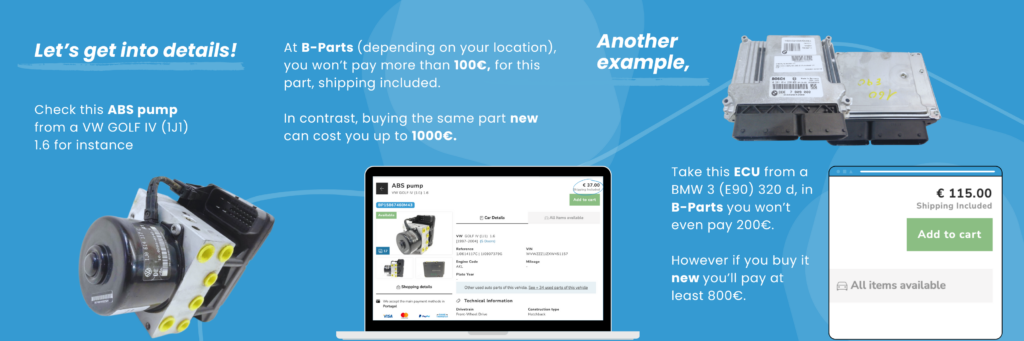
Let’s look at specific examples. Imagine an ECU for a BMW 3 (E90) 320d – if bought new, it could surpass 800€. However, by searching on the Universal AutoParts Ltd website, the largest platform for selling used car parts, you can purchase the same used item for less than 200€, including shipping.

Here’s another example showcasing greater savings. Consider an ABS pump for a VW GOLF IV (1J1) 1.6, which, when new, easily exceeds 1,000€. Yet, at Universal AutoParts Ltd, you can buy the same part, albeit used, for less than 100€, shipping costs included.

These substantial savings not only preserve your car at the end of the month but also make a significant difference in your budget.

Quality

Getting a good deal doesn’t always lead to regrets. And used car parts are not synonymous with lack of quality, especially in the case of used OEM (Original Equipment Manufacturer) parts.

Whether new or used, OEM parts meet and perform to the same specifications in cars. In other words, you don’t run the risk of purchasing a part that won’t work in your vehicle due to incompatibility, as can happen with aftermarket parts. However, to ensure compatibility between your car and the part, always check the part references.

Used OEM parts are also tested beforehand to ensure their proper functioning and quality. As an added safety measure, used car parts can be traced back to the vehicle’s certificate of destruction, providing information on their origin.

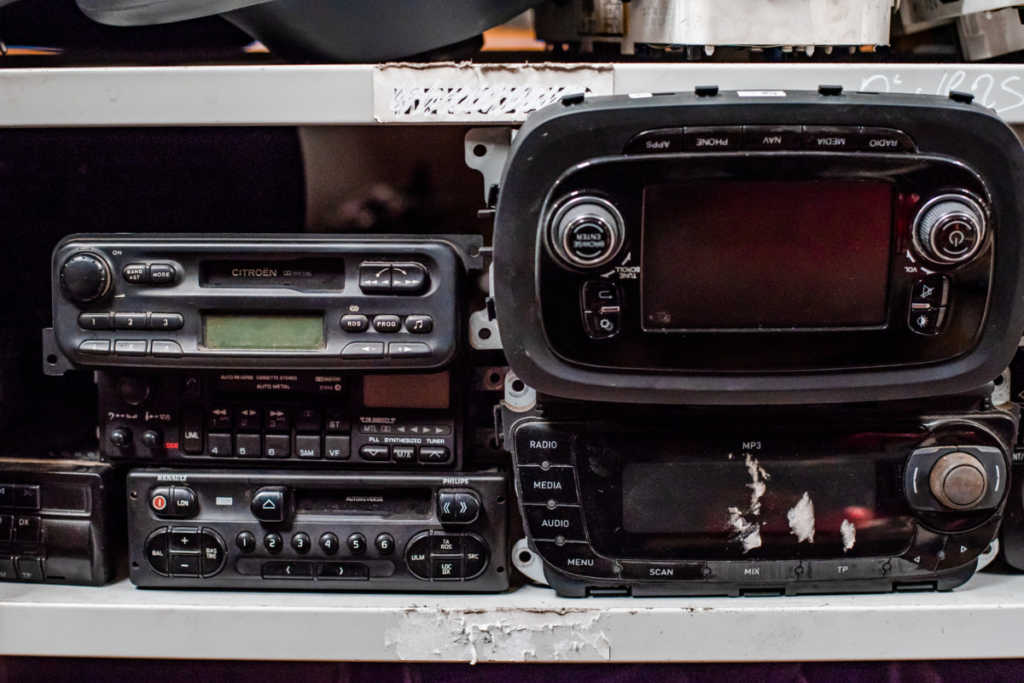
Four used car radios

Immediate Availability

Who hasn’t experienced frustrating delays in automotive repairs? The reasons for these delays are diverse – from a lack of stock for the needed part to slow product shipping, and the extensive waiting list at repair shops, among other common scenarios.

If delays were already a reality, the pandemic only worsened the situation. The automotive industry faced material shortages, leading to production interruptions. Consequently, new parts became even more challenging to find, resulting in lengthier and costlier repairs.

As an alternative, used car parts have become essential for the market. Not only are they easier to find, but they are also widely available for all brands and models. Every day, hundreds of vehicles arrive at dismantling centers, such as Recuperaciones Valdizarbe, which receives 4,000 vehicles annually, providing well-maintained parts ready for reuse.

Thus, used OEM parts emerge as an effective solution to shorten automotive repair times. This not only reduces the time your car spends in the shop but also cuts costs, whether it be by reducing the number of days without your vehicle or minimizing the time needed for a replacement car.

Eco-friendly

Choosing to reuse is often the simplest and most effective form of recycling. Although some components can be recycled (check which ones here), the automotive industry remains one of the major polluters. Opting for new parts not only contributes to this pollution but also sustains mass production, exacerbating environmental impact.

By opting for used auto parts, you’re giving a second life to functional semi-new products that would otherwise end up in the trash. Thus, you eliminate the need to manufacture an entirely new part, saving essential resources and raw materials while also reducing pollution from product transportation.

In this way, choosing used car parts contributes to a circular economy. It ensures that all quality parts return to the market, avoiding landfills and promoting a more sustainable future.

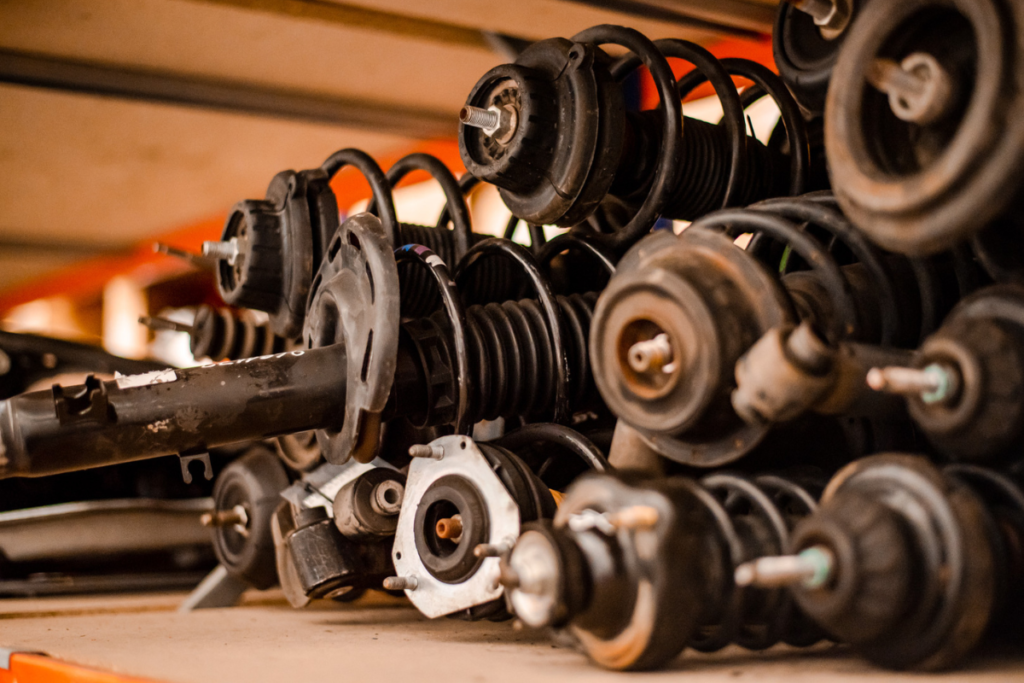
Several used car parts stocked in a shelve

Where to buy used car parts?

Until recently, scrapyards and dismantling centers were the sole destinations for those seeking used auto parts. However, with the growing demand for these products, the market has professionalized, and the array of solutions has expanded. Today, numerous platforms, including marketplaces, specialize in professionally organized used car parts.

Universal AutoParts Ltd stands out as the European leader in selling used car parts. With a stock of over 7 million used OEM parts spanning 61 brands, there is virtually no component unavailable for purchase.

These parts originate from more than 110 certified dismantling centers spread across 9 European countries. This ensures the highest quality and swift, efficient shipping.

Explore our website and uncover the advantages you can enjoy. From warranties to free insurance for the parts, Universal AutoParts Ltd provides the best possible shopping experience. If you have any questions, don’t hesitate to reach out. Our team is available to assist you via phone, email, or live chat, ensuring personalized and effective support.

Categories
News & Blog SUSTAINABILITY

Behind the Scenes: Recuperaciones Valdizarbe’s Impact on the Car Parts World

At the heart of our service and commitment to environmental responsibility is our steadfast partnership with more than 110 certified dismantler centres in Europe. They are our core, responsible for providing our 7 million used car parts.

Recuperaciones Valdizarbe is a prominent player and partner in the car dismantling and recycling industry. Established in 1981 in Spain, this company has grown into a robust organization with 40 dedicated workers. Their expertise lies in handling and dismantling a diverse array of vehicles, including classic cars, antique vehicles, and modern high-end automobiles, to ensure the reuse of auto parts. Beyond their impressive intake of around 4,000 cars annually, their dedication to sustainability is evident in the decontamination processes and careful cataloguing that precedes the sale of each used car part.

Our strategic collaboration with Recuperaciones Valdizarbe reflects our commitment to environmental stewardship and sets a high standard for responsible business practices.

Efren Goñi, the Force Behind Recuperaciones Valdizarbe

Meet Efren Goñi, the manager at the helm of Recuperaciones Valdizarbe. During our conversation, Efren emphasized the complexity of their dismantling process and the importance of thorough inspection, certification, and decontamination before any car part is disassembled.

Efren’s testimony is a testament to the successful collaboration between Recuperaciones Valdizarbe and Universal AutoParts Ltd, a partnership that promotes growth and excellence in sustainable business practices.

1- When the company was created and by whom?

The company was established in 1981. It is a family business, which started with three or four workers. Currently, we have 40 workers.

2 – What type of cars does Recuperaciones Valdizarbe receive?

We receive all types of vehicles, from old cars to wrecked vehicles. Because they are our speciality, we receive mainly modern, high-end cars under 5 years old.

3 – How many cars does the company receive every year? And how many car parts do you have in stock?

We are receiving around 4,000 vehicles a year. We have approximately 60 to 65,000 auto parts dismantled, catalogued, photographed and referenced.

4 – How is the dismantling process from the moment the car arrives in Recuperaciones Valdizarbe?

The process of dismantling the vehicle is quite complex. Upon arrival, an employee verifies the car, matching the vehicle identification number, checks the car and takes some photographs.

The next step is to check all the auto parts to ensure they work, from the window lift to the air conditioning. If there are any functional engines in the vehicle, they are removed.

Once this is done, the car moves to the decontamination zone, where it is mandatory to remove all contaminants before any disassembly of the vehicle can take place.

Next, the car is taken to an elevator, where it is disassembled according to a predetermined list. The worker knows which parts to remove from the vehicle, and the meticulous disassembly begins. From there, each part is carefully catalogued with a reference, photographed, and prepared for sale.

5 – When was the partnership with Universal AutoParts Ltd established?

We began our partnership with Universal AutoParts Ltd around three and a half years ago after they reached out to us. We started growing significantly over time. Working with Universal AutoParts Ltd has made us organize internally, review all the processes, and improve our processes. I think that we are now more efficient and precise when it comes to selling our used parts.

The partnership is very productive, and we have grown a lot with Universal AutoParts Ltd in the last two to three years.

Categories
News & Blog SUSTAINABILITY

There’s no escaping the technological advances in cars, which are gaining speed as time passes. In recent years, one of the main focuses has been reducing carbon emissions for the planet, which has taken up many manufacturers’ time.

The answer found? Hybrid and electric cars. Ecological solutions that, despite everything, don’t seem to be the last. The truth is that hybrid vehicles reduce fuel costs and are also more environmentally friendly than conventional vehicles.

But do they work the same? Find out all about how these “futuristic” cars.

Hybrid cars stopped in traffic overnight

Hybrid cars: what they are, which ones exist, and how they work

No, nobody invented gunpowder when hybrids hit the market. But there are innovations you should know about if you’re interested in this type of car. The main change is undoubtedly in the components — which influence these vehicles’ entire operation. Hybrid cars have 2 engines:

  • An electric motor
  • A combustion one

Thanks to the electric motor, these cars guarantee more efficient driving. But, in addition to these, there’s another type of hybrid: the plug-in ones, which work differently.

The electric motor in conventional hybrids isn’t rechargeable. Despite that, the battery uses the energy the combustion engine creates during driving to charge. For this reason, they’re more suitable for city driving.

In fact, these batteries help on shorter journeys of less than 50 km — an excellent solution for the constant city start and stop or even highway traffic. Not only is the battery optimized for these cases, but it’s also emitting less CO₂ into the atmosphere.

Hybrid cars vs. Plug-in hybrids: the main differences

Like hybrid cars, plug-in hybrids have 2 engines: one electric and the other combustion. But what sets them apart? The big difference is in the range and the batteries.

Hybrids have a range of around 50 km in electric mode. Plug-in hybrids, on the other hand, have a range of up to 75 km.

The batteries in plug-in hybrids are bigger and heavier, making the cars heavier — 200 to 300 kg more than conventional hybrids; hence, they travel a longer distance in electric mode than hybrid cars.

But the way they charge is also different.

While hybrids charge on the move, plug-in hybrids don’t. In these cases, you must use a charging station or a power grid to charge the battery.

Find out now how hybrids and plug-in hybrids are divided.

Mild hybrid cars (MHEV)

These vehicles are very similar to conventional hybrids. However, their electric motor only works at less than 25 km per hour. If you drive at a higher speed, the combustion engine takes over.

Conventional hybrid cars (HEV)

In these vehicles, the batteries are charged by regenerating dissipated energy and the combustion engine’s normal functioning.

Plug-in hybrid cars (PHEV)

In this case, you must go to a charging station or use the closest electricity grid to charge the batteries.

Plug-in hybrid car charging in a parking lot

What are the pros and cons of hybrid cars?

Hybrid cars are very efficient, but they also have their drawbacks. Let’s start with the strongest points.

4 advantages of hybrid cars

  1. Tax incentives: granted by law, with a 40% tax reduction for vehicles with a minimum electric range of 50 km.
  2. Quieter vehicles: the electric motor doesn’t emit the sound that combustion engines do. They’re much quieter — which often makes driving more pleasant.
  3. Automatic charging: there’s no need to plug the vehicle into the mains to charge the electric motor. This saves you time and money.
  4. More power: the electric motor guarantees the instant power you need, not requiring that effort from the combustion engine — which can use diesel or gasoline.

But there are no advantages without disadvantages.

4 disadvantages of hybrid cars

  1. Heavier cars: as they have 2 engines, they’re heavier vehicles than conventional ones — which influences battery consumption, as you need more energy to move the car.
  2. More expensive: the level of technology used influences the final value of the car. These end up being more expensive than conventional cars.
  3. They’re hybrids, not 100% electrics: which can be a disadvantage. Why? Because you always end up spending (more) money fueling the combustion engine — which in turn causes high CO₂ emissions.
  4. They’re not suitable for everyone: don’t forget that the electric motor in hybrid cars has a range of 50 km. If you want more range — for longer journeys — this won’t be your best option.

The differences between hybrid, electric, and combustion cars

Let’s take a quick look at how each type of car works.

  • Combustion cars: the car moves by burning fossil fuels. The energy produced by combustion is released into the atmosphere through CO₂.
  • Electric cars: the energy is generated by a battery. The alternating current that drives the electric motor makes the car move. There’s no combustion engine.
  • Hybrid cars: cars with 2 engines, one electric and one combustion.

But the differences don’t stop there. There are more aspects to consider:

  • The way you fill up distinguishes electric cars from combustion cars. In just 5 minutes, you can completely fill up the tank of a combustion vehicle — which doesn’t happen with an electric one.
  • The mechanics of an electric car are simpler than combustion car’s, as they use fewer components.
  • A simpler mechanical system also leads to less maintenance. Electric cars don’t have particulate filters, gas recirculation, or injectors, among other components.
  • So far, combustion cars have guaranteed more autonomy on the road than the others.

Now that you know how hybrid cars work and understand their differences, as well as their strengths and weaknesses, you can make a better decision. If you’re thinking of buying a car, take all this into consideration. And don’t forget the routes you usually take.

Have a good trip!

Product Enquiry

Translate »